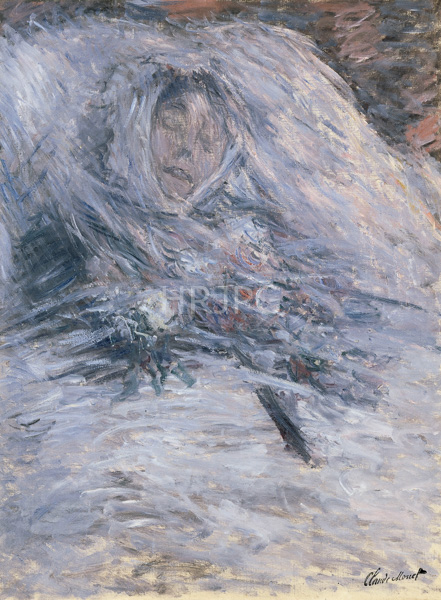
The visual impact of the painting is one of ethereal, chilling beauty. Camille’s face is shrouded in a veil of white and pale blue fabric, which seems to dissolve into the surrounding atmosphere. Monet utilizes a palette of cold, wintery tones—violets, grays, and icy whites—which reflect the stillness and the cold of the death chamber. The brushwork is exceptionally frantic and expressive, far removed from the rhythmic dabs of his sun-drenched landscapes. The strokes seem to swirl around Camille’s head like a spectral mist, creating a sense of movement that paradoxically emphasizes the absolute stillness of her features. There is no traditional detail; her closed eyes and pale lips are suggested by subtle tonal shifts rather than hard lines. The composition is tightly focused on her head and shoulders, pulling the viewer into an intimate and uncomfortable proximity to the reality of loss.
Technically, Camille Monet on her Deathbed is a masterpiece of atmospheric color theory applied to a tragic subject. Monet’s 'broken color' technique is used here to represent the dissolution of the physical body. The play of light on the white sheets and the floral offerings is captured with the same intensity he would use for a snow-covered field or a lily pond, yet here the effect is one of profound melancholy. The lack of black, even in such a somber work, remains consistent with his Impressionist principles; the 'darkness' of death is rendered through deep violets and blues. This work proves that Impressionism was not merely a style for cheerful subjects, but a powerful tool for exploring the most profound human experiences. The energy of the brushwork reflects the artist’s emotional turmoil, making the painting a rare instance where his technical process and his personal feelings are inextricably linked.
Historically, this painting remained in Monet’s personal collection until his death, a private memorial to the woman who had shared his years of poverty and early struggle. It marks a major turning point in his life; after Camille’s death, Monet’s work became increasingly focused on the landscape and less on the human figure. The painting is often discussed in relation to the 'ethics of seeing,' as it raises questions about the artist’s ability to remain an observer even in the face of personal tragedy. Today, housed in the Musée d'Orsay, it stands as one of the most moving and powerful portraits in the history of art. It is a work of unflinching honesty, reminding us that for Monet, the act of painting was a way of understanding and confronting the world in all its beauty and all its pain. It remains a timeless meditation on mortality, captured through the lens of a revolutionary artist who could not stop seeing, even when his heart was breaking.