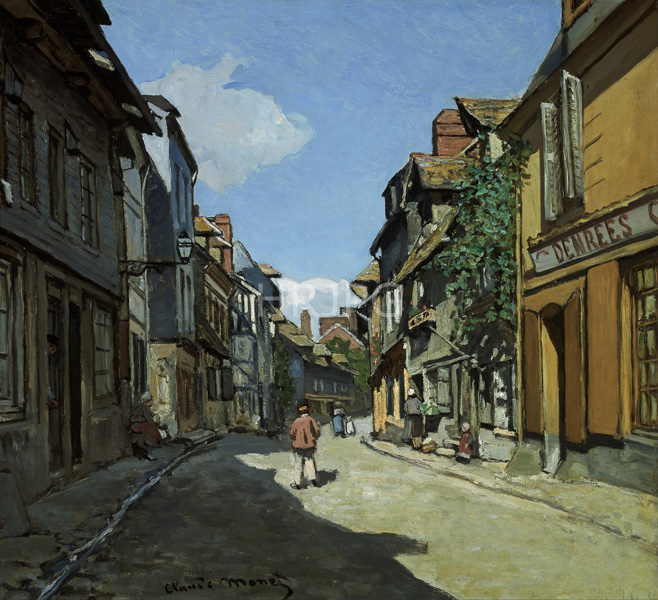
The visual center of the painting is the narrow, receding street of the Rue Bavolle, framed by the towering, timber-framed houses typical of Normandy. Monet uses the strong diagonals of the street and the rooflines to create a deep sense of perspective, drawing the viewer’s eye toward the church and the sliver of sky in the distance. The lighting is crisp and directional, suggesting a bright, clear afternoon. Monet captures the way the sunlight hits one side of the street while leaving the other in deep shadow, creating a powerful contrast that defines the architectural volumes. The figures in the street—a few local residents going about their daily business—are rendered with a quiet objectivity, providing a sense of scale and life to the scene. The color palette is dominated by earthy ochres, grays, and cool blues, reflecting the material reality of the stone and wood while maintaining a luminous, airy quality.
Technically, The La Rue Bavolle at Honfleur demonstrates Monet’s mastery of 'chiaroscuro' and his ability to handle complex light-and-shadow relationships. The brushwork is more controlled and descriptive than his later work, but there is already a sense of freedom in the way he handles the textures of the cobblestones and the weathered facades of the buildings. He uses a variety of marks to suggest the different materials, from the smooth plaster of the walls to the rough grain of the wooden beams. One can see the influence of Jongkind in the way Monet handles the sky and the reflections of light on the street, using small touches of bright color to give the scene a sense of atmospheric vibration. This work is a bridge between the tradition of topographical town views and the modern, sensory-focused cityscapes that Monet would produce later in his career, such as his views of Paris or London.
Historically, Monet’s time in Honfleur was crucial for his development. It was here that he learned to paint 'sur le motif' (on the spot), a practice that would become the foundation of Impressionism. The La Rue Bavolle at Honfleur reflects the artist’s early interest in the 'character' of a place, captured through the objective recording of light and form. The painting was a success for the young artist, showcasing his technical skill and his ability to find poetry in the everyday. Today, held in the Mannheim Kunsthalle, it remains a vital document of Monet’s early career and a beautiful example of 19th-century French realism. It serves as a reminder that Monet’s later experiments with light and color were built on a solid foundation of rigorous observation and a deep respect for the physical world. It is a work of enduring charm and structural integrity, capturing a quiet moment in the history of a small French town.