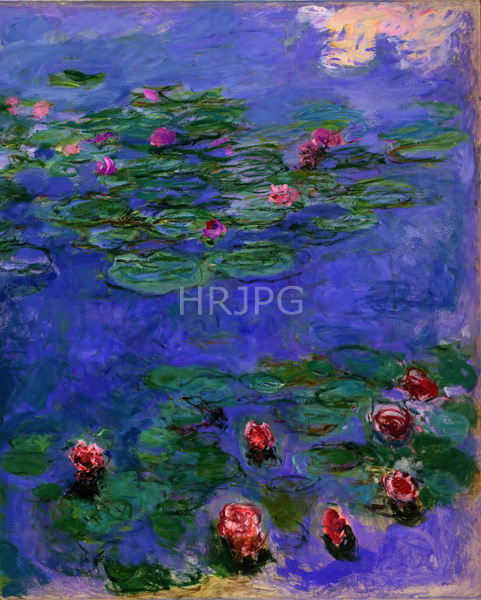
The visual logic of Red Water-Lilies is defined by its extraordinary "all-over" composition and the radical removal of any traditional spatial anchors. By this stage in his career, Monet had completely abolished the horizon line, the sky, and the shoreline, choosing instead to plunge the viewer directly into the water’s surface. This creates a deeply immersive experience, where the boundaries between reality and reflection are masterfully blurred. The composition is anchored by the rhythmic, floating islands of the lily pads, which Monet renders with a sophisticated sense of depth and perspective, despite the lack of a vanishing point. The vibrant, fiery reds of the lily blossoms act as visual beacons against the deep, murky blues and violets of the water, creating a chromatic tension that is both celebratory and intensely personal. This layering of light and matter creates a sense of infinite, weightless space within a shallow environment, a hallmark of his late-career genius that would eventually inspire the Abstract Expressionist movement decades later.
For Monet, the true subject of the painting was never the physical plants themselves, but the "envelope" (l’enveloppe)—the air and light that exists between the eye and the object. In this 1914-1917 composition, the envelope becomes dense, saturated, and increasingly non-naturalistic. This shift was partly due to the artist's developing cataracts, which altered his perception of the color spectrum toward reds, oranges, and deep purples. However, this physical limitation became an artistic liberation, allowing him to use color more expressively and intuitively. The water is not merely a body of liquid; it is a tapestry of vertical and horizontal brushstrokes that capture the flickering reflections of the overhead sky and the unseen weeping willow trees. Monet utilizes a sophisticated palette of deep indigos, saturated magentas, and brilliant whites to represent the filtered sunlight of the garden. This creates a unified tonal harmony that makes the atmosphere feel as physical and tangible as the organic forms floating upon it, transforming the pond into a theater of pure light.
The historical significance of the years 1914-1917 cannot be overstated when analyzing this work. While many young artists were at the front, Monet remained at his easel, often working on massive canvases in his new, light-filled studio. Red Water-Lilies serves as a testament to his unrelenting creative spirit during a time of immense personal and national grief. The fiery reds of the blossoms have often been interpreted by art historians as a subtle, perhaps subconscious reflection of the blood and fire of the war, yet the overall mood remains one of profound stillness and quiet meditation. This juxtaposition of intense color and serene subject matter creates a visual poetry that is uniquely Monet. He recognized that nature offered a source of eternal return, and by documenting the quiet rhythms of his garden, he provided a visual sanctuary—a "refuge for peaceful meditation"—that aimed to heal the spirit through the direct observation of beauty.
Technically, this work showcases Monet’s mastery of "broken color" and a radical rejection of traditional academic finish. He applied the paint in thick, rhythmic layers of impasto, building up a textured surface that has a physical presence of its own. He famously avoided the use of black entirely, opting instead for saturated purples, deep blues, and murky greens in the shadows to maintain a high-keyed luminosity throughout the entire composition. The brushwork in the blossoms is exceptionally free and gestural, reflecting the speed and intuition required to record the shifting patterns of light before they vanished. From a distance, the diverse pigments merge in the viewer’s eye, creating a shimmering, lifelike effect that mimics the actual mechanism of human vision. This focus on the "instantaneity" of the moment ensures that the painting feels alive and breathing, capturing not just a garden, but a fleeting sensation of time itself.
Historically, Red Water-Lilies remains a cornerstone of the modern art legacy. Initially misunderstood by critics as the blurred scribblings of an old man with failing sight, these works were rediscovered in the mid-20th century by artists like Mark Rothko and Joan Mitchell, who saw in Monet’s late work the foundations of large-scale abstraction. Monet’s victory over the material world was absolute; he proved that by looking deeply enough at a single patch of water, one could find the infinite. This painting bridges the gap between the 19th-century landscape tradition and the visionary, light-obsessed masterpieces of the modern era. It reminds us that for Monet, the world was never a collection of static objects, but a continuous, shimmering vibration of color, air, and light, forever captured through an honest, revolutionary, and deeply resilient eye.