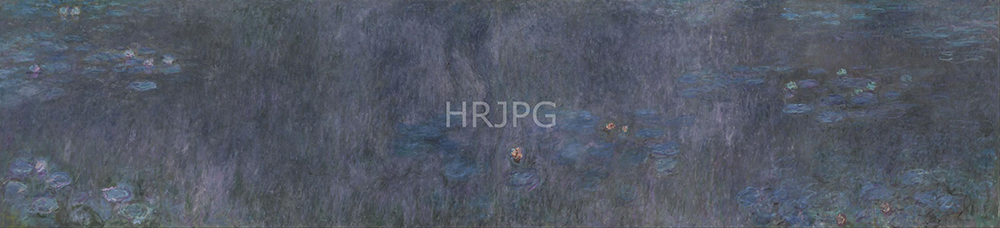
The visual logic of Tree Reflections is defined by its extraordinary horizontality and the radical removal of the horizon line, the sky, and the shoreline. The viewer is no longer standing on a bank looking at a pond; instead, they are suspended directly over the liquid mirror of the water, engulfed in a seamless, "all-over" composition. This immersive quality was intended by Monet to offer a "refuge for peaceful meditation" to the weary citizens of Paris following the slaughter of World War I. The composition is anchored not by solid objects, but by the rhythmic, vertical reflections of the weeping willow trees. These dark, pendulous forms cut across the horizontal plane of the lily pads, creating a sophisticated grid that suggests immense depth within a shallow, flat environment. By removing any traditional spatial orientation, Monet forces the eye to wander across the canvas, mimicking the natural movement of water and the shifting focus of human consciousness.
For Monet, the true subject was always the "envelope" of light that unifies all elements within a single field of vision. In this late series, the envelope becomes dense, saturated, and deeply psychological. Monet utilizes a sophisticated palette dominated by deep indigos, murky violets, and lush emerald greens to represent the shaded, evening light of the pond. Because his vision was increasingly affected by severe cataracts during this period, his perception of color shifted toward the warmer end of the spectrum and deep, saturated tones. This physical limitation became an artistic liberation, allowing him to use color expressively rather than descriptively. The reflections of the willows are not merely shadows; they are vibrations of dark purple and blue that absorb the light, creating a sense of silence and stillness. The water lilies themselves appear as rhythmic islands of pale pink and white, acting as flickering highlights that prevent the viewer from sinking entirely into the dark depths of the water.
The historical context of the Great War is essential to understanding the gravity of this work. As the sound of artillery reached Giverny, Monet remained dedicated to his garden, treating the act of painting as an act of resistance and resilience. The weeping willow trees featured in Tree Reflections were a deliberate symbol of mourning for the fallen soldiers of France. However, by capturing their reflections in the calm, eternal surface of the pond, Monet transformed a symbol of grief into a symbol of continuity and peace. This juxtaposition of the vertical, mournful trees and the horizontal, life-bearing lilies creates a visual tension that is both somber and celebratory. It illustrates the master’s ability to find a universal language for human emotion in the familiar rhythms of his own backyard, turning a private sanctuary into a monument of national healing.
Technically, the 1914-1926 water lily cycle showcases the birth of a new artistic language. Monet applied the paint in thick, crusty layers of impasto, building up a textured surface that has a tangible, sculptural presence. He abandoned the small, staccato brushstrokes of high Impressionism in favor of large, sweeping gestural movements that reflect the physical energy of his entire body. He famously avoided the use of black entirely, using saturated indigos and violets in the shadows to maintain a high-keyed luminosity even in the darkest recesses of the pond. This technique ensured that every inch of the massive canvas vibrated with energy, mimicking the actual experience of human vision, which perceives the world as a continuous flux of light rather than a collection of static, bordered objects. This "broken color" approach ensures that from a distance, the diverse pigments merge in the viewer’s eye, creating a shimmering, lifelike effect that feels as if the water is actually moving.
Historically, Tree Reflections and the Orangerie cycle remain among the most radical and influential achievements in modern art history. Initially misunderstood by some critics as the blurred scribblings of a diseased eye, these works were "rediscovered" in the 1950s by the Abstract Expressionists. Artists like Jackson Pollock and Mark Rothko looked to Monet’s late water lilies as the foundation for their own immersive, non-objective canvases. Monet’s victory over the material world was absolute; he proved that by looking deeply enough at a single patch of water, one could find the infinite. This painting stands as a moving testament to his unrelenting creative spirit and his ability to see through the darkness of his own failing sight to find a visionary, eternal light. It remains a cornerstone of the Impressionist legacy, inviting us to lose ourselves in the vibration of color and to find, in the reflection of a tree, a sense of universal harmony and profound, wordless peace.