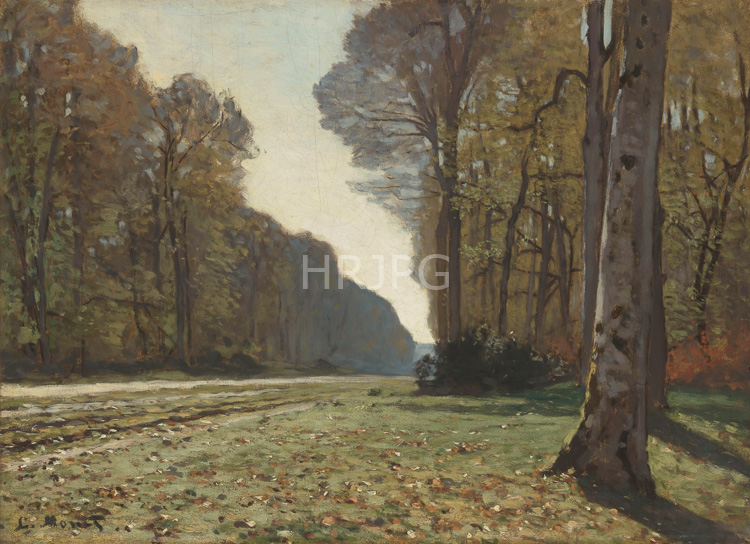
The visual center of the painting is the long, receding road that draws the viewer’s eye deep into the forest. Monet uses the 'pavé' (the paved road) as a strong geometric element that provides a sense of structure and scale to the composition. The towering oak trees that line the road are rendered with a powerful sense of mass and volume, their dark trunks providing a vertical counterpoint to the horizontal expanse of the sky. The light in the painting is crisp and directional, suggesting a bright autumn or spring afternoon. Monet captures the way the sunlight filters through the canopy, creating patches of brilliant gold on the road and the surrounding foliage. The shadows are deep and rich, yet they contain subtle tonal variations that suggest the complexity of the forest floor. Unlike his later works where forms dissolve into light, here the forms are solid and grounded, reflecting his early commitment to the material reality of the natural world.
Technically, Le Pavé de Chailly showcases Monet’s mastery of 'chiaroscuro' and traditional perspective. The brushwork is vigorous and confident, with a focus on capturing the different textures of the bark, the stones, and the leaves. He uses a palette of earthy ochres, deep greens, and rich browns, accented by the brilliant blues of the sky. This work was originally intended as a study for his massive, never-completed project 'Le Déjeuner sur l'herbe,' which aimed to integrate figures into a modern landscape. Even as a landscape study, it stands as a complete and powerful work of art. The way Monet handles the vast, empty space of the road was highly innovative, reflecting his interest in the candid, unposed views that would later become a hallmark of the Impressionist movement. He was moving away from the 'picturesque' toward a more direct and honest record of the world.
Historically, the Forest of Fontainebleau was the cradle of modern French landscape painting, and Monet’s engagement with this site placed him in direct dialogue with masters like Camille Corot and Théodore Rousseau. However, Monet’s vision was already more modern and objective. Le Pavé de Chailly represents the moment when the young artist began to assert his independence, seeking to capture the 'instantaneity' of light in a large-scale format. The painting was well-received by his contemporaries and remains one of the highlights of his early oeuvre. Today, housed in the Musée d'Orsay, it serves as a reminder of Monet's deep roots in the tradition of French landscape painting and his role in transforming that tradition into something entirely new. It is a work of immense structural and visual power, capturing the majesty of the forest and the quiet, enduring beauty of the rural landscape.