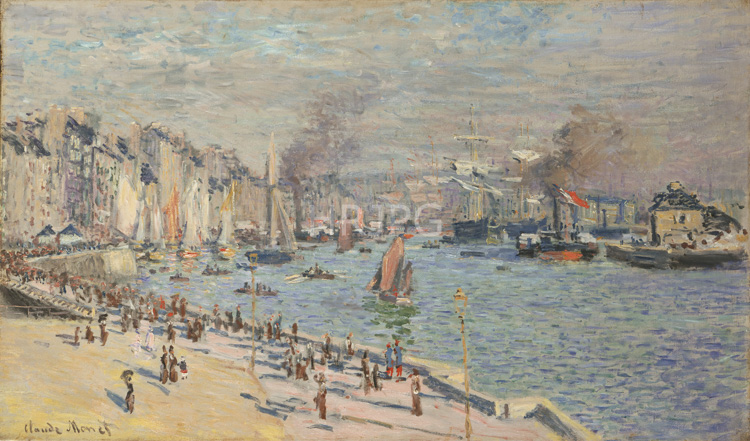
Claude Monet painted the masterful and historically significant work The Port of Le Havre (Le Port du Havre) in 1874, a year that stands as the definitive watershed moment in the history of Western art. This was the year of the first Impressionist exhibition, and Monet returned to the maritime environment of his youth to document the rapid industrialization of France. While his more famous work from this period, Impression, Sunrise, offered a poetic and near-abstract view of the harbor, The Port of Le Havre provides a more structured, panoramic, and socio-economic investigation of the "envelope" of light and atmosphere. It is a work of immense structural clarity and optical truth, showcasing a master at the peak of his mature powers, using the bustling Grand Quai as a scaffolding for a revolutionary investigation into the nature of perception.
I. The Compositional Logic: Perspective and Motion
The visual logic of the painting is anchored by the extraordinary diagonal of the Grand Quai, which slices across the lower left quadrant of the canvas. This architectural element provides a strong structural framework, leading the viewer’s eye from the foreground crowds into the hazy, industrial depth of the harbor.
The Foreground Crowd: Monet renders the figures on the pier with a characteristic Impressionist shorthand—staccato dabs of dark pigment that suggest the movement and anonymity of the modern urban middle class. These figures are not portrait subjects but rhythmic elements that provide a sense of scale and human vitality against the vastness of the sea.
The High-Angled Perspective: By adopting a slightly elevated vantage point, Monet creates a sprawling, immersive field of vision. This allows him to balance the heavy, textured mass of the stone pier with the fluid, shimmering surface of the water and the immense, moisture-laden sky above.
Horizontal Rhythms: The masts of the sailing ships and the vertical plumes of smoke from the steamships create a series of rhythmic accents that punctuate the horizontal planes of the horizon, establishing a sophisticated grid of light and form.
II. The Atmospheric "Envelope": Light as a Filter
For Monet, the true subject of the painting was never the ships or the stone, but the "envelope" (l’enveloppe)—the air and light that exists between the eye and the object. In this 1874 composition, he explores the specific lighting conditions of a bright yet hazy day, where the industrial grit of the port merges with the natural moisture of the English Channel.
Monet utilizes a sophisticated and restricted palette of cool grays, pale azures, and muted ochres to represent this filtered sunlight. The sky is a masterclass in atmospheric observation; he uses varied brushwork to suggest the weight of the clouds and the way the sun struggles to penetrate the industrial smog. This creates a unified tonal harmony that makes the air feel as physical and tangible as the stone buildings in the distance. The "temps gris" (gray weather) effect is not depicted as somber but as a shimmering, iridescent veil that unifies the diverse elements of the harbor into a single, cohesive "impression."
III. The Industrial Modernity: Steam vs. Sail
The Port of Le Havre serves as an essential document of the 19th-century transition between the old world and the new. Monet was a "painter of modern life," and he found a monumental, almost cathedral-like beauty in the gritty reality of the technological revolution.
The Heroism of Modern Life: The deep, dark plumes of smoke rising from the steamships are treated with the same aesthetic reverence as the scudding clouds. Monet recognizes that the smoke is a visual participant in the atmosphere, altering the color and texture of the light.
Technological Contrast: The slender, elegant masts of the traditional sailing vessels provide a nostalgic vertical rhythm that contrasts with the heavy, functional forms of the modern steamers. This juxtaposition illustrates the rapidly changing world of the late 19th century, where the port of Le Havre acted as a gateway for global commerce and progress.
Optical Mixing: Rather than blending colors on the palette, Monet applied dabs of pure color—reds, blues, and whites—directly to the water’s surface. From a distance, the viewer's eye performs "optical mixing," creating the sensation of flickering, moving light on the ripples of the Seine.
IV. Technical Brilliance: Texture and the Rejection of Black
Technically, this work showcases Monet’s mastery of "broken color" and his radical rejection of traditional academic chiaroscuro.
The No-Black Rule: Even in the deepest shadows of the ship hulls and the dark coats of the strollers, Monet avoids the use of flat black. Instead, he utilizes deep indigos, saturated purples, and cool emeralds to maintain a consistent luminosity throughout the entire composition. This ensures that the shadows remain "filled with light," a hallmark of the Impressionist revolution.
Impasto and Surface: He used a confident, impasto technique to build up the surface of the stone pier and the white crests of the water. This gives the painting a tangible, sculptural presence that mirrors the materiality of the port itself. The brushwork is exceptionally free and spontaneous, reflecting the speed required to capture the "instantaneity" of the shifting light.
Color Theory: Notice the subtle use of warm ochres in the sand and stone to provide a chromatic counterpoint to the dominant blues and grays of the water. This use of complementary colors makes the atmosphere vibrate with a natural intensity.
V. Historical Significance and Legacy
Historically, the works produced in 1874 represent the moment when art broke away from descriptive realism to embrace the visionary power of pure perception. While the critics of the time famously mocked these works for appearing "unfinished," today we recognize them as the foundation of modern art.
The Port of Le Havre is more than a topographical record; it is a celebration of the human eye’s ability to find harmony in the chaos of a working city. It bridges the gap between the Realist foundations of Monet’s youth and the visionary abstraction of his final years. By turning a site of industrial labor into a theater of light, Monet reminded the world that beauty is not found in the subject itself, but in the way the light touches it.