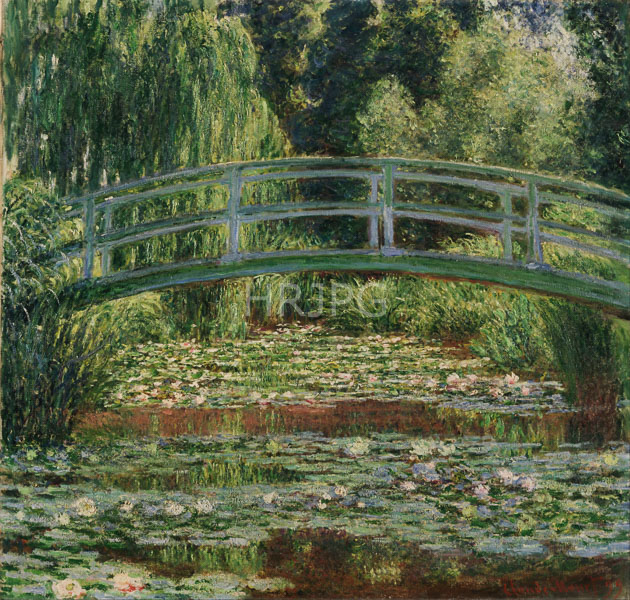
The composition is elegantly organized around the graceful curve of the bridge, which provides a strong horizontal and vertical framework for the scene. This structure is balanced by the vertical lines of the weeping willows and the vibrant, organic forms of the reeds and water lilies below. Monet uses a lush and varied palette of greens—from deep forest tones to pale chartreuse—to create a dense wall of vegetation that shuts out the world beyond the garden. The sunlight filters through the trees, dappling the surface of the water and hitting the top of the bridge’s railing. The water lilies themselves are rendered as small, rhythmic dots of white, pink, and yellow, floating on the dark, reflective surface of the pond. The 'Sun Effect' in this work is subtle but pervasive, creating a sense of a warm, still summer morning where the air is thick with the scent of flowers and the sound of water.
Technically, The Japanese Footbridge displays Monet's mastery of 'all-over' texture. The entire surface of the canvas is built up with a complex weave of brushstrokes, varying from long, fluid lines for the willow branches to short, thick dabs for the water lilies. This creates a vibrating, tapestry-like quality that captures the sensory overload of a thriving garden. Monet’s use of color in the shadows is particularly sophisticated; beneath the bridge, the shadows are filled with cool purples and deep emeralds, suggesting the cool dampness of the water’s surface. He avoids traditional perspective in favor of a layered approach, where the depth is suggested through the overlapping of foliage and the recession of the bridge. This focus on the immersive, decorative quality of nature reflects his interest in Japanese aesthetics, where the goal is to capture the 'spirit' of the landscape rather than a literal, topographic record.
Historically, the 1899-1900 series of the Japanese bridge was a critical triumph, establishing the Giverny garden as one of the most famous sites in modern art history. These works reflect a period of artistic synthesis for Monet, where he combined his early Impressionist focus on light with a more structured and decorative approach to composition. They set the stage for the radical late works where the bridge would disappear and the viewer would be plunged directly into the water. The Japanese Footbridge and the Water Lily Pool remains one of the most beloved images in the history of Western art, symbolizing the ideal of a man-made paradise. Today, held in the National Gallery in London, it continues to inspire millions with its vision of peace, beauty, and the restorative power of nature. It is a cornerstone of Monet’s legacy, illustrating the perfect union between the artist’s hand and the world he created.