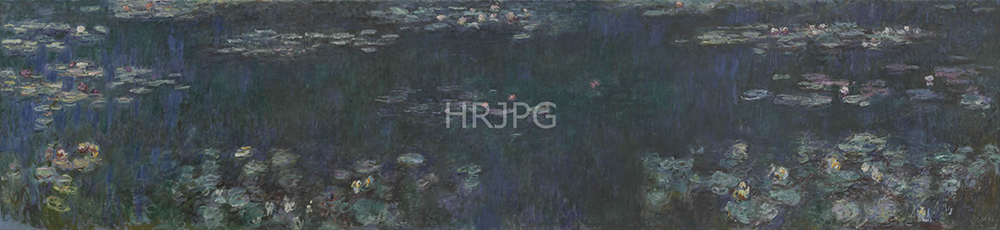
The composition of Green Reflections is revolutionary for its complete abandonment of traditional perspective. There is no sky, no shore, and no horizon line; the viewer is positioned as if floating in the center of the pond. The primary subject is the water itself, acting as a dark, liquid mirror for the surrounding weeping willows and the overhead atmosphere. Monet uses a palette dominated by deep emerald, forest green, and murky olive, punctuated by the brilliant whites and pale pinks of the floating lilies. The 'Green Reflections' of the title refer to the submerged shadows of the trees that seem to stretch across the surface like ethereal curtains. These reflections provide a vertical rhythm to the otherwise horizontal expanse of the pond, creating a sense of profound depth and mystery. The water is not a static surface but a living entity, vibrating with the movement of light and the invisible currents beneath.
Technically, the 1914-1915 period saw Monet’s brushwork become increasingly broad and gestural. Because he was working on such a large scale, he used long-handled brushes and moved his entire body to apply the paint in rhythmic, sweeping motions. The paint is often layered and scumbled, creating a complex surface that shifts and changes as the viewer moves in front of the canvas. This 'all-over' technique ensures that every part of the painting is alive with activity, yet the overall effect is one of serene harmony. Monet’s mastery of 'broken color' is at its peak here; the greens are composed of countless shades of blue, yellow, and violet, allowing the eye to mix the colors and experience the 'shimmer' of the water garden. This focus on the optical experience of a total environment was a radical innovation that would influence the development of site-specific art and abstraction in the decades to follow.
Historically, the Water Lilies series was Monet’s gift to the French nation at the end of World War I, intended as a monument to peace and a tribute to the fallen. Green Reflections was eventually installed in the specially designed oval rooms of the Musée de l'Orangerie in Paris, where it remains today. For many years, these late works were dismissed as the 'senile' products of a failing artist, but their rediscovery in the mid-20th century transformed our understanding of modern art. They are now recognized as the ultimate expression of the Impressionist ideal—capturing the 'fugitive' nature of reality while simultaneously achieving a sense of the eternal. Green Reflections is a masterpiece of light and atmosphere, a work that dissolves the physical world into a symphony of color and reflection. It stands as a testament to Monet's enduring genius and his ability to turn a private garden into a universal space of beauty and contemplation.