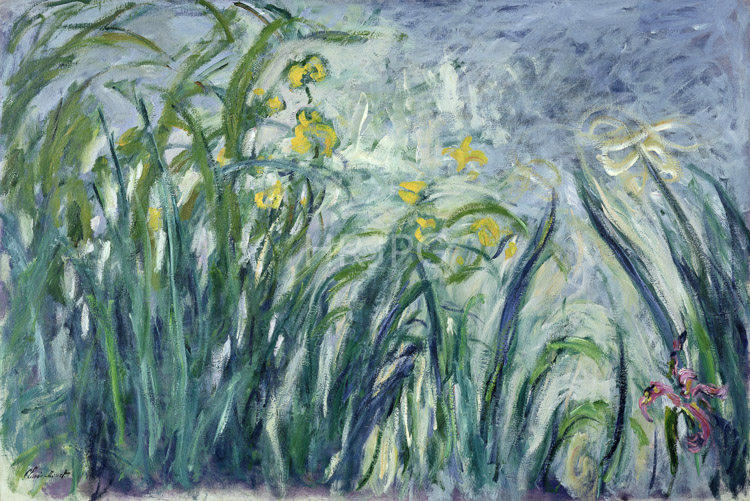
The visual logic of the painting is dictated by the intense, almost non-naturalistic palette of yellow and mauve. Due to his cataracts, which caused a yellowing of his vision and a struggle to perceive blues and violets, Monet’s late works often moved toward extreme ends of the spectrum. In this canvas, the 'Yellow' is a brilliant, fiery ochre and lemon that seems to radiate heat, while the 'Mauve' is a deep, saturated purple that provides a heavy, structural contrast. The brushwork is incredibly bold and gestural; Monet used large brushes and applied the paint in thick, sweeping arcs that follow the upward growth of the iris petals. There is a sense of desperate energy in these marks, as if the artist were reaching out to grasp the essence of the flowers before they vanished from his sight. The background is a hazy, atmospheric blend of greens and earthy tones, which creates a shallow space that pushes the flowers directly into the viewer's face.
Technically, Yellow and Mauve Irises is a radical departure from traditional floral still life or landscape. There is no horizon line and very little sense of grounding; the irises seem to float or explode within the frame. Monet was no longer interested in the 'envelope' of light in a scientific sense, but in the 'vibration' of color as a carrier of emotion. The thick layers of paint, often applied wet-on-wet, create a textured surface that has a physical presence of its own. This 'all-over' composition, where every inch of the canvas is treated with equal intensity, was a precursor to the Abstract Expressionism of the mid-20th century. By 1924, Monet was painting more from memory and inner feeling than from direct observation, leading to a work that feels hauntingly modern. The irises are transformed into symbols of resilience, their vibrant colors defying the encroaching darkness of the artist's failing vision.
Historically, Monet’s late iris paintings were long misunderstood by critics who viewed them as the tragic results of a diseased eye. It was not until the 1950s that art historians and artists like Jackson Pollock and Mark Rothko recognized these works as visionary leaps into abstraction. Yellow and Mauve Irises shows Monet at his most daring, abandoning the rules of Impressionism to find a new visual language. The painting is a record of a man wrestling with time and mortality, using his garden as a sanctuary and a laboratory for the future of art. Today, held in the National Gallery in London, the work is celebrated for its raw power and its profound beauty. It remains a cornerstone of 20th-century art, proving that even at eighty-four, Monet was still the most radical painter of his age, capable of turning a simple flower into a monumental exploration of light and the human spirit.