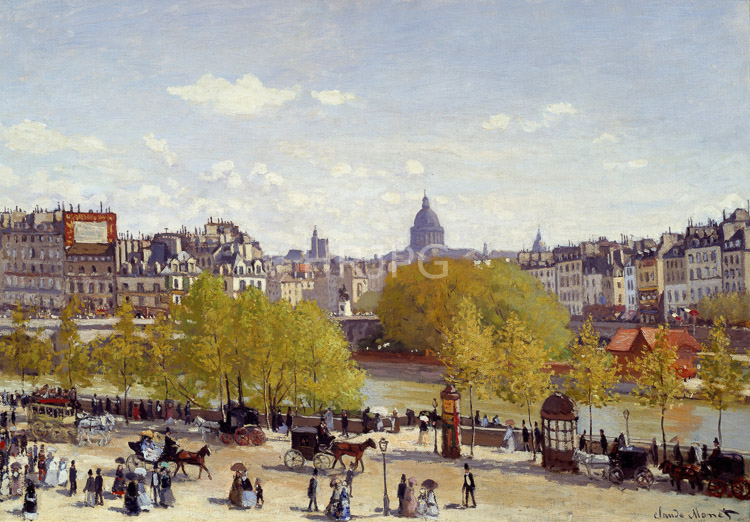
The visual center of the painting is the Quai du Louvre itself, a wide, sun-drenched thoroughfare teeming with the motion of the 19th-century city. From his high balcony, Monet recorded the carriages, the pedestrians, and the kiosks as small, abbreviated dabs of color. This 'sketch-like' treatment of the urban crowd was revolutionary; it captured the fleeting, transient nature of modern life rather than focusing on the permanent, static details of individuals. The light in the painting is crisp and clear, reflecting a bright spring afternoon. Monet uses a palette of cool blues, warm ochres, and brilliant whites to define the architecture and the atmosphere. The Seine, visible in the background, is rendered with horizontal strokes that suggest its movement and the reflection of the sky. The overall effect is one of extraordinary luminosity and space, conveying the vast scale and energy of the French capital.
Technically, Quai du Louvre shows the influence of Monet's early mentor, Eugène Boudin, who encouraged him to record the first 'impression' of a scene. However, Monet’s handling here is more structured than his later work, reflecting his early interest in perspective and architectural form. The strong diagonals of the quay and the vertical lines of the buildings provide a solid framework for the composition. Yet, within this structure, the brushwork is remarkably fluid and spontaneous. Monet’s focus on the 'envelope' of light is already evident; the way the sunlight bleaches the colors of the pavement and the way the shadows are filled with cool tones shows his emerging understanding of optical truth. This painting is not a historical record of a monument, but a record of a specific moment of light and life in a rapidly changing city.
Historically, the Louvre series is significant because it marks Monet’s break with the academic tradition of landscape painting. Instead of seeking beauty in the ruins of the past or the wildness of nature, he found it in the heart of the modern city. This move toward 'contemporary realism' was a key tenet of the Impressionist movement. Quai du Louvre is also notable for its connection to the history of photography; the high vantage point and the blurred motion of the figures mimic the aesthetic of early photographs of Paris. Today, housed in the Mauritshuis in The Hague, the painting is celebrated as one of the first truly 'modern' depictions of a city. It remains a powerful testament to the young Monet’s vision and his ability to see the world with a fresh, unmediated eye, setting the stage for the artistic revolutions that would define the rest of his career.