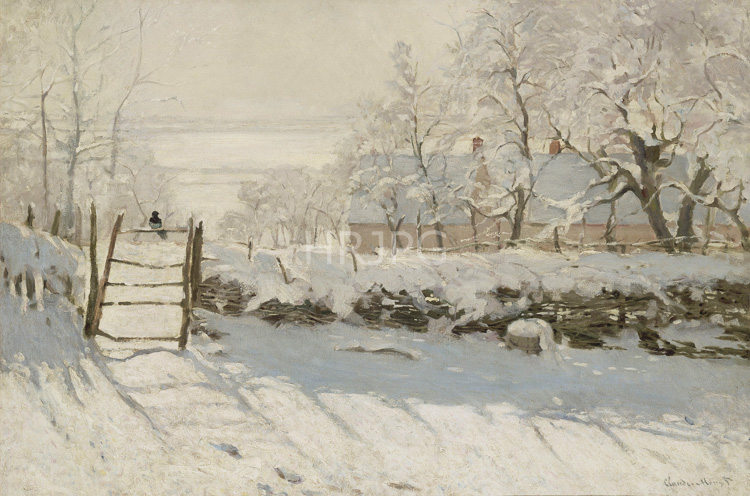
The visual revolution of The Magpie lies in Monet's treatment of shadows. Before the Impressionists, shadows were traditionally rendered using black or dark brown pigments to indicate a lack of light. However, Monet observed that on a bright, sunny winter day, shadows on snow actually appear blue, as they reflect the color of the clear sky. In this painting, the shadows cast by the gate and the stone wall are rendered in brilliant, luminous shades of blue and lavender. This discovery was shocking to contemporary audiences and critics, who found the 'blue shadows' unnatural. Today, however, it is recognized as a profound optical truth. The snow itself is not a uniform white; Monet uses a complex palette of creams, pinks, and grays to suggest the varying textures of the frozen ground and the way the low winter sun rakes across the surface.
The composition is elegantly structured, with the horizontal line of the snow-covered fence and the vertical posts of the gate creating a skeletal frame for the landscape. The lone magpie, a small black-and-white accent on the gate, provides a focal point and a sense of life within the silent, frozen scene. The trees in the background are rendered with a soft, atmospheric haze, suggesting the crispness of the winter air. Monet’s brushwork is varied and confident; he uses thick, textured impasto to represent the heavy drifts of snow on the gate and fence, while using thinner, more fluid strokes for the distant sky. This tactile quality gives the painting a sense of physical reality, making the viewer almost feel the biting cold and the stillness of the Normandy morning.
Historically, The Magpie is seen as a manifesto of the young Monet’s artistic independence. By focusing on the fleeting effects of light on a mundane subject—a simple gate in a snowy field—he was asserting that the artist's perception is the ultimate subject of art. The rejection of this work by the Salon only solidified Monet's commitment to finding a new visual language outside the academic establishment. This painting paved the way for the development of Impressionism in the 1870s, where 'truth to nature' meant capturing the optical sensation of light rather than a literal description of objects. Now a treasure of the Musée d'Orsay, The Magpie continues to captivate viewers with its serene beauty and its pioneering exploration of color. It remains a timeless masterpiece that forever changed how we see the color of shadows and the quiet majesty of winter.