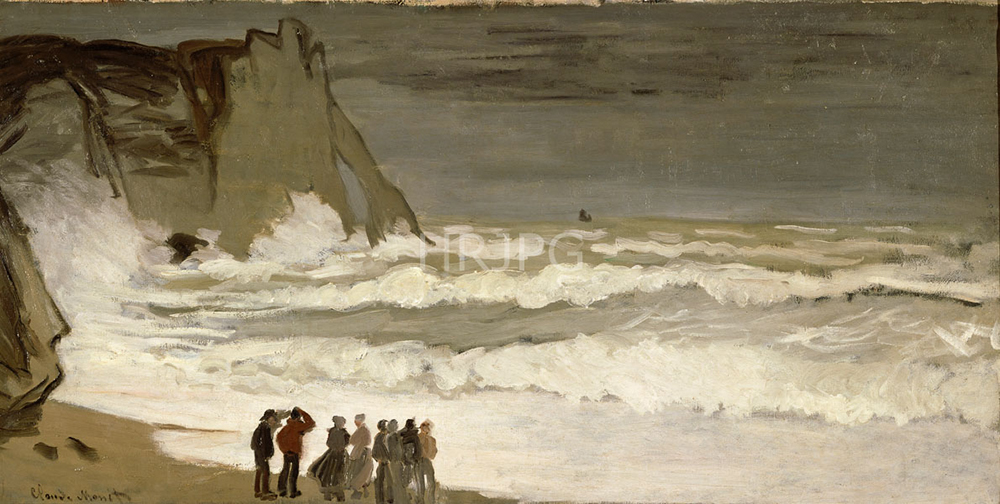
The composition is anchored by a low, dramatic viewpoint that plunges the viewer directly into the churning surf. The foreground is dominated by the 'rough sea' of the title, where Monet uses a sophisticated palette of leaden grays, deep greens, and brilliant whites to depict the crashing waves and the swirling foam. The brushwork here is exceptionally vigorous and textured; he uses thick, gestural strokes of impasto to represent the physical mass of the water and the spray of the foam. Unlike the more delicate, flickering strokes of his later work, the handling here is broad and muscular, reflecting the influence of Gustave Courbet’s 'The Wave' series. However, Monet’s approach is more atmospheric; he is less interested in the sculptural form of a single wave and more focused on the overall 'impression' of the storm—the way the moisture-laden air blurs the horizon and softens the jagged edges of the cliffs.
Technically, Rough Sea at Etretat is a masterclass in the use of restricted color to create mood and depth. The sky is a heavy, overcast expanse of gray and pale yellow, suggesting the cold, diffused light of a winter storm. This flat light eliminates strong highlights and forces the artist to rely on subtle tonal variations to define the space. The cliffs are rendered in muted earthy tones, their verticality providing a structural counterpoint to the horizontal chaos of the water. One can see Monet’s early interest in the reflective properties of light even in this somber palette; the white foam of the waves catches what little light filters through the clouds, creating flashes of brilliance that guide the eye through the composition. The presence of a few small, dark fishing boats on the shore provides a sense of scale and highlights the vulnerability of human activity in the face of nature’s overwhelming power.
Historically, this painting represents a pivotal moment in Monet’s transition from a realist to a proto-impressionist. It showcases his commitment to direct observation of nature in its most extreme states, a practice that required him to work in challenging and often dangerous conditions on the Normandy coast. This dedication to 'truth'—not as a literal description of objects, but as a record of a visceral sensory experience—became the foundational principle of the Impressionist movement. Rough Sea at Etretat was a critical success, demonstrating that the young Monet could handle traditional landscape themes with a modern, innovative sensibility. Today, housed in the Musée d'Orsay, the painting remains a powerful testament to the artist’s lifelong obsession with the sea and his extraordinary ability to capture the fleeting, ephemeral quality of water and light. It stands as a bridge between the Romantic tradition of the sublime and the modern focus on optical perception, reminding us of the revolutionary spirit that sought to record the raw heartbeat of the natural world.