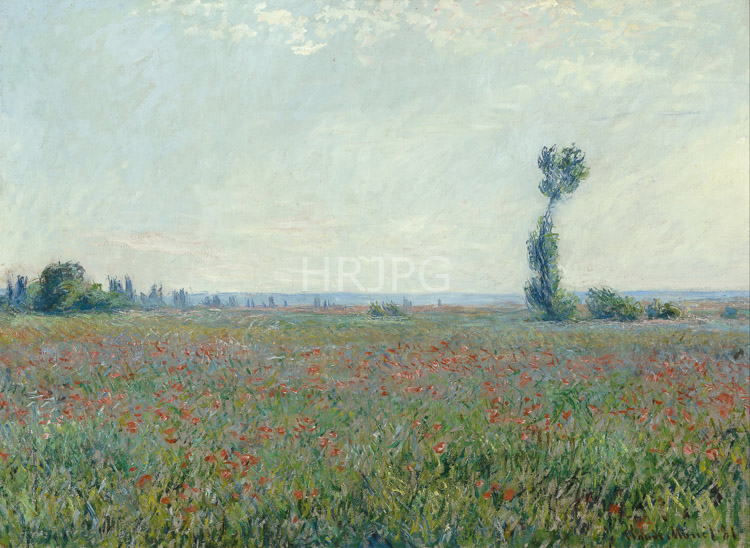
The visual logic of the painting is defined by the extraordinary use of complementary colors—specifically the vibrant red of the poppies against the lush, varied greens of the meadow grass. Monet understood that placing these colors side-by-side would make them both appear more intense to the human eye, a principle of color theory that he utilized to create a sense of shimmering vitality. The poppies are rendered as small, rhythmic dabs of pure red pigment, which seem to dance across the canvas as the eye moves through the field. The figures of Camille and Jean appear twice—once in the upper left on the ridge of the hill, and again in the lower right foreground. This repetition creates a sense of movement and narrative, suggesting the slow, leisurely progress of a walk through the tall grass. The figures are rendered with an abbreviated shorthand, their forms dissolving into the light and atmosphere of the scene, which emphasizes that they are an integral part of nature rather than separate from it.
Technically, Poppy Field showcases Monet's masterful use of broken brushwork. Rather than blending colors on the palette to create smooth transitions, he applied strokes of pure, unmixed color directly to the canvas, allowing the viewer's eye to perform the 'optical mixing' at a distance. This technique gives the painting its characteristic brightness and energy. The sky is rendered with soft, atmospheric washes of pale blue and white, suggesting a light, breezy day where the clouds are in constant motion. The shadows in the grass are not black or gray, but are filled with cool blues and deep greens, reflecting the color of the sky and the density of the foliage. This rejection of traditional chiaroscuro in favor of color-based shadows was a radical departure from the academic style and allowed Monet to capture the 'envelope' of light that unifies the entire landscape.
Historically, Poppy Field was one of the central works exhibited at the first Impressionist exhibition in 1874. At the time, critics were shocked by its 'unfinished' appearance and the lack of traditional detail, but today it is recognized as a visionary achievement. It reflects the post-war optimism of early 1870s France and the growing cultural importance of suburban leisure. By choosing a mundane, everyday subject—a walk in a field—and elevating it through his innovative use of light and color, Monet challenged the established hierarchies of art. The painting is a celebration of the present moment, a record of a peaceful afternoon that remains as fresh and vibrant today as it was over a century ago. Currently held in the Musée d'Orsay, it remains a cornerstone of the Impressionist movement, illustrating Monet's lifelong commitment to capturing the fleeting beauty of the natural world through a purely optical lens.