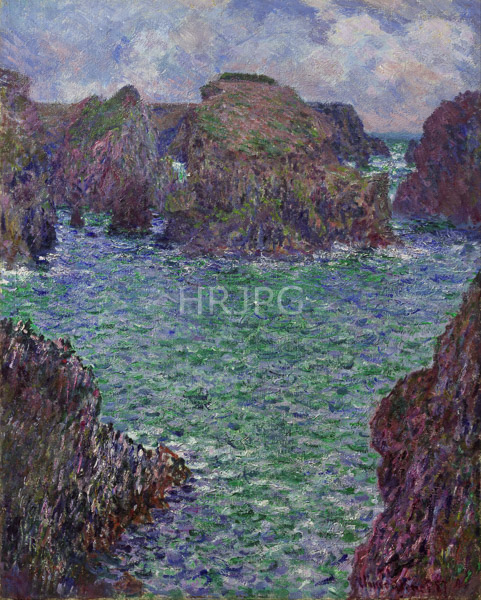
The visual center of the painting is the complex interplay between the solid, ancient rocks and the churning, fluid energy of the water. Monet uses a daring palette of deep purples, emerald greens, and vibrant blues to depict the sea, while the rocks are rendered in earthy ochres and dark browns. The shadows within the rock crevices are filled with saturated violets, reflecting his mature understanding of color theory. The brushwork is incredibly energetic and rhythmic, echoing the movement of the tides and the wind-swept texture of the cliffs. Rather than painting the rocks as static objects, Monet treats them as dynamic forms that change their appearance as the light hits their faceted surfaces. This focus on the 'vibration' of light on rugged surfaces creates a sense of movement and life, making the viewer feel the physical force of the Atlantic coast.
Technically, Port-Goulphar Belle-Ile showcases Monet's struggle with the concept of 'instantaneity' in a wild environment. He famously wrote to Alice Hoschedé that the weather at Belle-Île was so unpredictable that he had to work on dozens of canvases at once to keep up with the changing light. This led to a more fragmented and gestural style, where the paint is applied in thick, expressive slashes. The composition is tightly focused, almost claustrophobic, pulling the viewer into the rocky embrace of the inlet. By eliminating the horizon line in many of these works, Monet emphasizes the immersive quality of the landscape, focusing entirely on the textures of rock and water. This approach anticipates the near-abstraction of his later Water Lilies series, where the boundaries between the physical world and the painted surface begin to blur.
Historically, the Belle-Île series represents a pivotal moment in Monet's career, as it proved that Impressionism could handle subjects of grandeur and 'the sublime' just as effectively as the quiet suburban scenes of Argenteuil. The works were a critical success when exhibited, with many reviewers praising Monet's ability to capture the 'soul' of the rugged coast. They also reflect the growing interest in regionalism and the search for a raw, 'authentic' French landscape. Port-Goulphar Belle-Ile remains one of the most iconic images of this period, a testament to Monet's relentless curiosity and his willingness to risk his physical safety (he often painted on precarious ledges) to achieve his artistic vision. Today, held in the collection of the Art Gallery of New South Wales, it continues to inspire awe for its scale, its color, and its powerful evocation of the untamed natural world. It is a masterpiece of landscape painting that bridges the gap between the observation of nature and the expressive power of modern art.