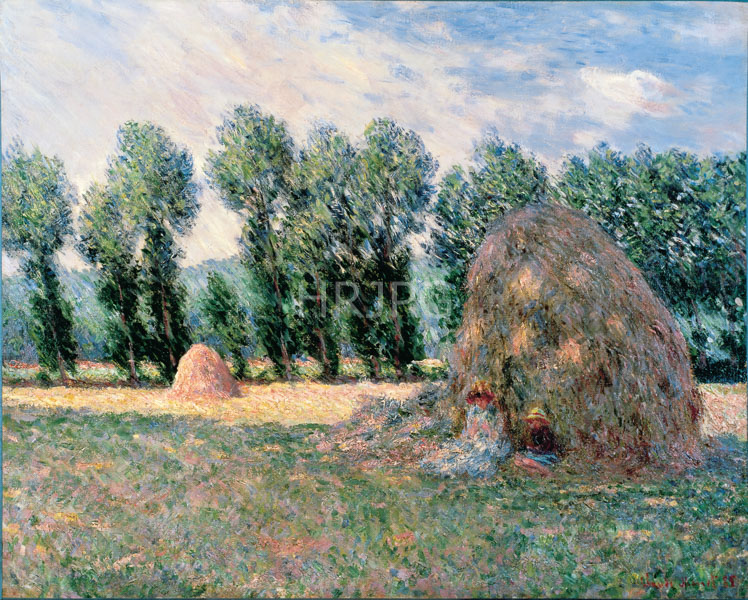
The visual impact of The Stacks at Giverny Sunrise is achieved through an extraordinary use of color and texture. As the sun begins to rise, the haystacks—ordinarily mundane agricultural objects—are transformed into monumental forms of glowing light. Monet uses a palette of fiery oranges, soft violets, and cool blues to depict the interaction of the morning sun with the frost and shadow of the field. The stacks themselves are not rendered with outlines but are built up through layers of thick, encrusted paint that capture the physical presence of the hay while reflecting the ethereal quality of the light. The long shadows cast by the stacks are filled with deep purples and blues, contrasting with the brilliant gold of the sunlit edges. This mastery of tonal relationships allows the painting to vibrate with energy, capturing the 'instantaneity' of the morning effect before the sun climbs higher and changes the scene entirely.
Technically, this work represents the pinnacle of Monet's series method. He would often have multiple canvases lined up, switching between them as the light shifted every few minutes. This obsessive dedication allowed him to record the most subtle nuances of atmospheric change. In Sunrise, the brushwork is dense and rhythmic, following the rounded shapes of the stacks and the flat expanse of the field. The sky is a masterclass in atmospheric perspective, with the soft, hazy light of dawn blurring the horizon and creating a sense of infinite space. By choosing such a simple, repetitive subject, Monet forced the viewer to focus entirely on the medium of paint and the behavior of light. This move toward a more abstract and subjective representation of reality was a radical departure from his earlier, more descriptive landscapes and paved the way for the development of modern art in the 20th century.
Historically, the exhibition of the Grainstacks series in 1891 was a massive success, both critically and commercially. It established Monet as the preeminent landscape painter of his generation and proved that the 'impression' could be a deep, sustained exploration of a single theme rather than just a quick sketch. The series influenced countless artists, from Kandinsky to the Abstract Expressionists, who saw in Monet's dissolving forms a new way of looking at the world. The Stacks at Giverny Sunrise remains a cornerstone of this achievement, illustrating the artist’s belief that reality is a fluid construct, shaped by the light in which we see it. Today, it stands as a testament to Monet's physical and artistic endurance, reminding us that even the most common objects can become extraordinary when viewed through the eyes of a master who is truly attuned to the rhythms of nature.