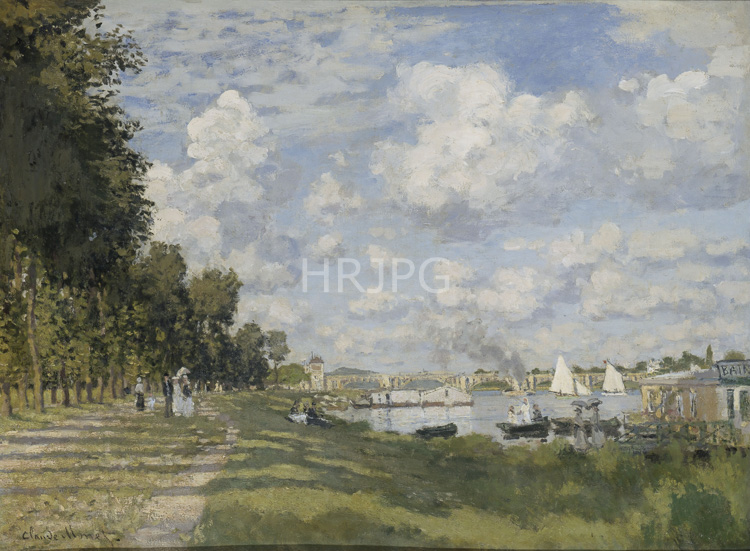
The true subject of the painting is the surface of the water and the way it acts as a mirror for the sky and the objects around it. Monet uses bold, horizontal strokes of pure color—azure, white, and ochre—to represent the reflections of the sailboats and the sky. This technique was revolutionary because it bypassed the traditional method of blending colors to create a smooth, glassy surface. Instead, Monet’s 'broken' brushwork suggests the gentle movement of the river and the shimmering quality of the light. The sailboats, with their vertical masts, provide a rhythmic structure to the composition, breaking the horizontal planes of the water and the distant shoreline. The interplay between the solid forms of the boats and their fluid, shifting reflections creates a visual vibration that gives the painting its life and energy.
Technically, The Port at Argenteuil shows Monet moving toward a higher-keyed palette. The shadows under the boats are not black or gray, but are composed of deep blues and greens, reflecting his growing understanding of how colors interact in nature. The sky is rendered with soft, atmospheric strokes, suggesting a clear, sunny day. The buildings in the distance are simplified into geometric shapes of light and shadow, highlighting Monet’s interest in the overall 'envelope' of light rather than architectural precision. This focus on optical truth—painting what the eye sees rather than what the mind knows to be there—is the core of the Impressionist revolution. The painting feels like a candid, spontaneous observation, yet it is organized with a sophisticated sense of balance and harmony that leads the viewer’s eye through the depth of the harbor.
Historically, this work represents the peak of the 'Argenteuil period,' a time when Monet, Renoir, and Sisley often painted side by side. The town became a symbol of the modern French landscape, where traditional river life coexisted with new forms of leisure and industrial growth. The Port at Argenteuil is a celebration of this new reality, finding beauty in the masts of modern yachts and the quiet corners of the suburban riverfront. Today, as part of the Musée d'Orsay's collection, it stands as a testament to the period when Impressionism first fully realized its visual language. The painting remains a timeless celebration of water and light, capturing a moment of serene modern life with a freshness that continues to captivate audiences, reminding us of the revolutionary spirit that sought to record the beauty of the contemporary world.