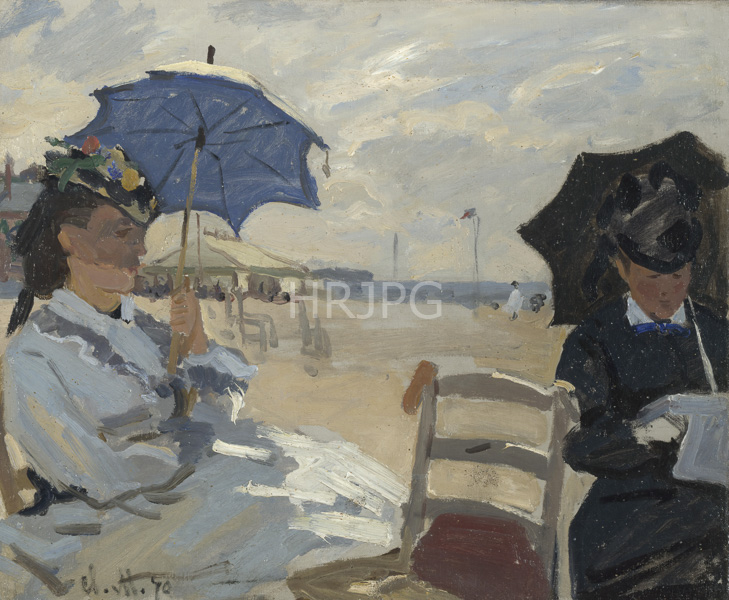
The most famous aspect of this painting’s physical history is the presence of actual sand grains embedded in the thick layers of oil paint. This detail provides tangible proof that Monet painted directly on the beach, undeterred by the wind that blew the shoreline into his wet canvas. This raw, unmediated connection to the environment is reflected in the brushwork, which is exceptionally broad and abbreviated. The women’s faces are barely defined, yet their presence is felt through the weight of their dresses and the tilt of their heads. Monet uses brilliant whites and cool grays to depict the sunlight hitting the fabric, while the shadows are rendered with subtle blues that reflect the overhead sky. By simplifying the figures, Monet shifts the viewer's focus away from the identity of the subjects and toward the overall atmospheric effect—the way the brilliant coastal light bleaches the color from the sand and creates a shimmering haze over the water.
The composition is anchored by the vertical lines of the women's figures and the dark structural accents of the chairs and umbrellas, which contrast sharply with the expansive, horizontal planes of the sand and the sea. The low horizon line gives the sky a dominant role, allowing Monet to explore the movement of scudding, wind-blown clouds with thick, energetic strokes of impasto. This equality of treatment between human figures and the natural elements was a radical departure from the academic tradition, which typically subordinated the landscape to the human narrative. Here, the landscape and the figures are unified by the same laws of light and atmosphere. The painting feels like a candid snapshot, anticipating the influence that photography would have on the Impressionists' desire to capture the 'unrepeatable moment.' The intensity of the light is almost palpable, making the viewer feel the warmth of the sun and the coolness of the sea breeze.
In the context of Monet’s career, The Beach at Trouville marks a period of transition and struggle. Shortly after painting this scene, the outbreak of the Franco-Prussian War forced Monet and his family to flee to London, beginning a period of exile and financial hardship. However, this work remains a pure celebration of visual perception, untouched by the political turmoil of the time. It demonstrates the influence of Eugène Boudin, who first encouraged Monet to paint the sea, while also showcasing Monet's superior ability to synthesize complex visual data into a cohesive, vibrant whole. Today, housed in the National Gallery in London, it is considered one of the most important works of early Impressionism. It remains a manifesto of the artist’s commitment to truth—not a literal, descriptive truth, but the optical truth of how we perceive the world in a single, fleeting instant.