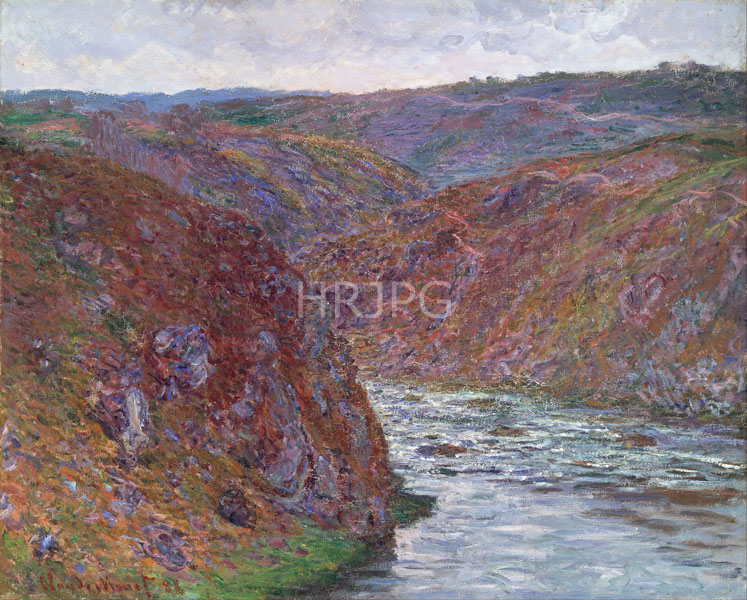
The painting is characterized by a powerful sense of mass and primordial structure. The hills, rendered in a sophisticated palette of deep mauves, ochres, dark greens, and slate blues, seem to roll across the canvas with the rhythmic energy of waves. Because the scene is captured under the diffuse light of a 'gray day,' the colors are saturated and brooding rather than brilliant, creating a mood of quiet intensity and profound solitude. Monet’s brushwork here is remarkably dense and rhythmic; the strokes follow the steep contours of the land and the rocky outcroppings, building up a textured surface that reflects the harshness of the environment. The lack of direct sunlight forced Monet to rely entirely on subtle tonal shifts and value relationships to create a sense of depth and volume. The result is a landscape that feels incredibly solid and ancient, yet also fluid and constantly changing under the shifting mist and moisture of the atmosphere. The river at the bottom of the valley is a winding thread of silver-gray, acting as a mirror for the dull sky above and providing a focal point that anchors the vastness of the surrounding hills.
Technically, Valley of the Creuse Gray Day is a masterclass in atmospheric perspective. The distant hills are shrouded in a cool, misty haze, their forms softened and simplified by the humidity in the air. This creates a powerful contrast with the more defined and heavily textured foreground, where the brushstrokes are more visible and vigorous. Monet famously struggled with the unpredictable weather during his three-month stay in the Creuse; he was obsessed with maintaining the specific lighting for each canvas in the series. He notoriously complained in his letters about the sun appearing when he wanted clouds, and vice versa, leading him to paint multiple versions of the same view simultaneously to capture every nuance. He even went so far as to pay a local landowner to strip the leaves off an oak tree that had begun to bud in the spring, simply so he could finish a 'winter' version of the scene with the correct skeletal branches. This level of dedication to 'instantaneity'—the capturing of a specific moment of light—is what gives this painting its hauntingly real quality.
The historical importance of the Creuse series within Monet’s oeuvre cannot be overstated. It marks the definitive transition into his late style, where the physical subject matter begins to dissolve into a complex surface of color, light, and texture. By returning to the same vantage point day after day, Monet was exploring the limits of human perception and the impossibility of ever truly 'finishing' a landscape, as it is transformed by every passing cloud and every minute change in the sun’s position. Valley of the Creuse Gray Day is a profound meditation on the permanence of the earth versus the transience of the atmosphere. It is a work that demands slow, contemplative looking, revealing its complexity only as the viewer’s eye adjusts to its subtle chromatic rhythms. Today, it stands as a testament to Monet’s physical and artistic endurance and his unrelenting quest to capture the true essence of nature in its most quiet and brooding moods. It remains a cornerstone of his series-based practice, illustrating the vital bridge between 19th-century realism and the emerging abstractions of the early 20th century.