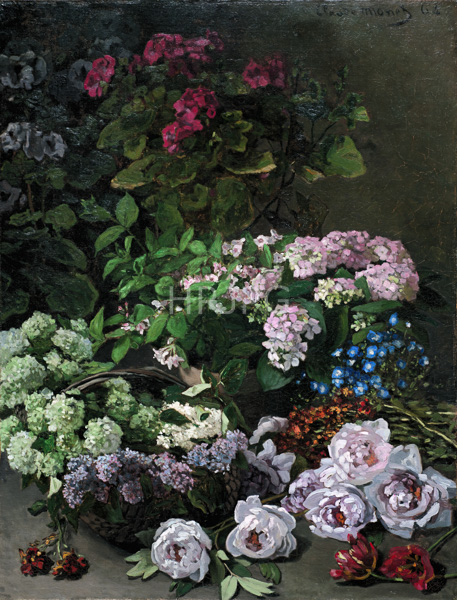
The internal logic of Spring Flowers is driven by the sheer variety of floral forms and the complex interplay of colors. Monet treats each species of flower with a distinct textural weight; the heavy, multi-petaled peonies are rendered with thick, creamy brushstrokes that suggest their soft density and fragrant weight, while the delicate clusters of hydrangeas are captured with lighter, more staccato touches. The palette is a sophisticated orchestration of deep magentas, soft pinks, and brilliant whites, all accented by the cool, varied greens of the leaves. One can observe Monet’s burgeoning fascination with how light penetrates translucent petals and creates deep, saturated shadows within the dense bunches of the bouquet. Unlike the static and often stiff flower paintings of the previous century, there is a palpable sense of vitality and growth here, as if the flowers have just been gathered from a sun-drenched garden and placed on the table, still holding the freshness and moisture of the spring air.
The composition is deceptively simple but carefully balanced to create a sense of dynamic energy. The diagonal sweep of the floral arrangement from the upper left toward the lower right leads the viewer’s eye through the painting, while the dark background is not a flat void but is filled with subtle shifts in tone and value that provide a sense of three-dimensional space and atmosphere around the bouquet. The tabletop, rendered with broad and confident strokes, provides a solid, horizontal anchor for the verticality of the vase and flowers. Interestingly, at this early stage of his career, Monet was still looking toward the influence of masters like Delacroix and the Dutch still-life tradition, yet he was already beginning to simplify forms and prioritize the overall visual effect. The way the light catches the curved rim of the vase and the edges of the fallen petals on the table reveals a keen interest in the optics of reflection and shadow that would eventually become the cornerstone of his mature Impressionist style.
In the broader context of Monet’s life, Spring Flowers was produced during his time in the studio of Charles Gleyre, where he met and bonded with future fellow Impressionists like Pierre-Auguste Renoir, Frédéric Bazille, and Alfred Sisley. This work represents a critical bridge between his academic training and his emerging obsession with the natural world. It demonstrates that even within the confines of a traditional still-life arrangement, Monet was primarily interested in the behavior of light as it interacts with organic matter. The painting was a success in his early career, showcasing his technical virtuosity and his ability to handle complex color relationships without losing the freshness of the subject. Today, as a highlight of the Cleveland Museum of Art’s collection, this painting reminds us that Monet’s journey toward abstraction and the pure depiction of light was grounded in a deep, early appreciation for the tangible, material beauty of nature. It remains a timeless celebration of renewal and the ephemeral beauty of spring, captured with a technical brilliance and emotional resonance that has not faded in over a century and a half of history.