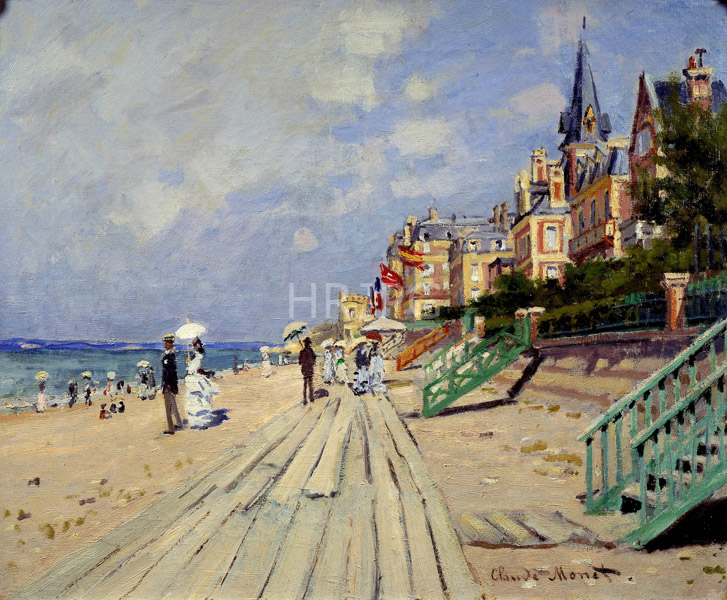
The physical reality of the painting’s creation is literally embedded in its surface; microscopic analysis has revealed grains of sand trapped within the oil paint, proving that Monet worked 'en plein air' (in the open air) directly on the shoreline. This commitment to working outdoors, regardless of the coastal breezes that blew sand onto his canvas, allowed him to achieve a level of optical truth that was revolutionary. The brushwork in The Beach at Trouville is exceptionally bold and abbreviated. Monet avoids fine detail in the women’s faces, rendering them as simplified forms of light and shadow, yet their postures and the weight of their flowing garments convey a tangible sense of presence and leisure. He utilizes broad, flickering strokes of white and pale blue to depict the brilliant sunlight hitting the fabric and the shifting, reflective surfaces of the distant sea and sky. By reducing the figures to essential shapes, Monet forces the viewer’s eye to perceive the scene as a unified whole, where human beings and nature are treated with equal artistic weight, both subject to the same atmospheric forces.
The composition is anchored by a low horizon line, granting the sky—filled with scudding, wind-blown clouds—a dominant role in establishing the painting’s emotional tone. These clouds are rendered with a thick, gestural impasto that suggests the physical movement of the air. The rhythm of the composition is punctuated by the vertical accents of the umbrellas and the dark, structural lines of the chairs, yet these elements are handled with the same fluid, sketch-like quality as the natural landscape. This refusal to over-refine the image was a radical departure from tradition; it asserted that the 'impression' of a moment was a complete work of art in itself. Monet was not interested in telling a story about the bathers, but in exploring the optical reality of how sunlight bleaches color from the sand and how shadows in bright daylight are not black, but filled with reflected blues and violets from the sky above. The stark contrast between the luminous sand and the dark accessories creates a high-keyed visual intensity that mirrors the actual experience of a bright, windy day by the ocean.
Historically, The Beach at Trouville stands at the threshold of the formal birth of Impressionism. It reflects the deep influence of his mentor Eugène Boudin, who first encouraged the young Monet to take his easel outdoors, while also demonstrating Monet’s superior ability to organize complex light into a cohesive visual language. Despite the personal joy of his marriage, this was a time of great political anxiety as the Franco-Prussian War loomed, eventually forcing Monet to seek refuge in London. However, none of this external turmoil enters the frame; the painting remains a pure, joyous celebration of visual perception. It is a manifesto of the sketch as a final statement, a bold claim that the artist’s immediate perception of light and color is the ultimate subject of modern painting. Today, housed in the National Gallery in London, the painting continues to serve as a primary document of the revolutionary spirit that sought to record the heartbeat of a single, unrepeatable moment in time. The legacy of this work lies in its unflinching honesty and its vibrant celebration of the natural world, paving the way for a century of art that would prioritize the artist’s inner vision over objective representation.