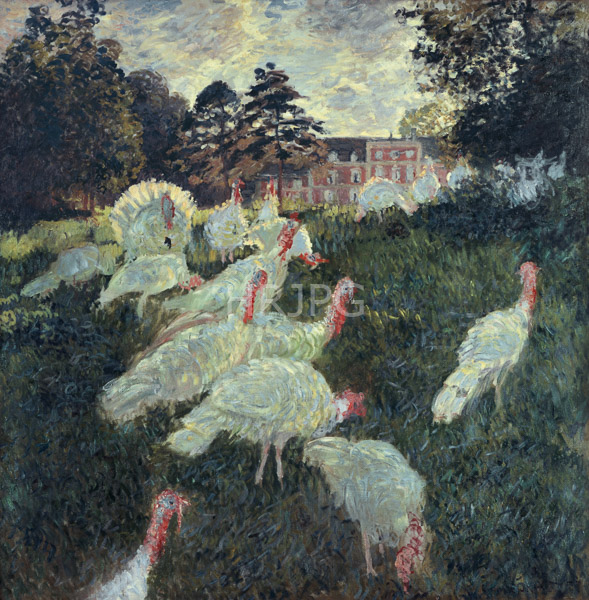
The composition is notably vertical, a choice that emphasizes the depth of the field and the upward reach of the trees. The turkeys themselves are rendered as brilliant patches of white and cream, their forms defined more by the way they catch the light than by precise anatomical detail. Monet captures the chaotic but rhythmic movement of the birds as they forage, using their bright plumage to create a visual counterpoint to the deep, textured greens and earth tones of the grass. In the shadows cast by the birds and the surrounding foliage, Monet employs his characteristic use of complementary colors—purples, blues, and cool greens—to suggest depth without relying on traditional black pigments. The interplay of light on the turkeys' feathers creates an almost iridescent quality, making the subjects appear as if they are glowing within the natural landscape. This focus on the "envelope" of light surrounding the objects is a hallmark of Monet's mature Impressionist style.
Technically, The Turkeys showcases Monet's increasingly bold brushwork. The grass is not a uniform green but a complex weave of emerald, ochre, and pale yellow strokes that suggest the varied textures of the meadow. The trees in the background are handled with a soft, atmospheric touch, creating a sense of receding space that draws the viewer's eye toward the horizon. The decorative nature of the commission allowed Monet to experiment with a more open and fluid style than his smaller gallery paintings. The scale of the birds relative to the landscape creates a sense of immersion; the viewer feels as though they are standing on the lawn of the château, witnessing a fleeting moment of rural life. The painting reflects the prosperity and leisure of the Hoschedé estate, yet it remains firmly rooted in Monet's obsession with the transient effects of the weather and the sun's position.
The historical context of The Turkeys is also significant, as it represents one of the rare instances where Monet worked on a coordinated decorative scheme. Ernest Hoschedé was an early and vital patron of the Impressionists, and this commission gave Monet the financial freedom to experiment with large-scale compositions. Unfortunately, Hoschedé’s eventual bankruptcy meant that the decorative ensemble was never completed as originally planned, and the panels were eventually dispersed. However, The Turkeys remains a testament to Monet's ability to elevate a seemingly mundane agricultural subject into a work of high art through the transformative power of light. The painting challenges the traditional hierarchy of subjects, asserting that the play of light on a turkey’s wing is just as worthy of artistic exploration as any classical theme. It serves as a precursor to his later series paintings, where the subject becomes a vehicle for exploring the infinite variations of light and atmosphere over time.