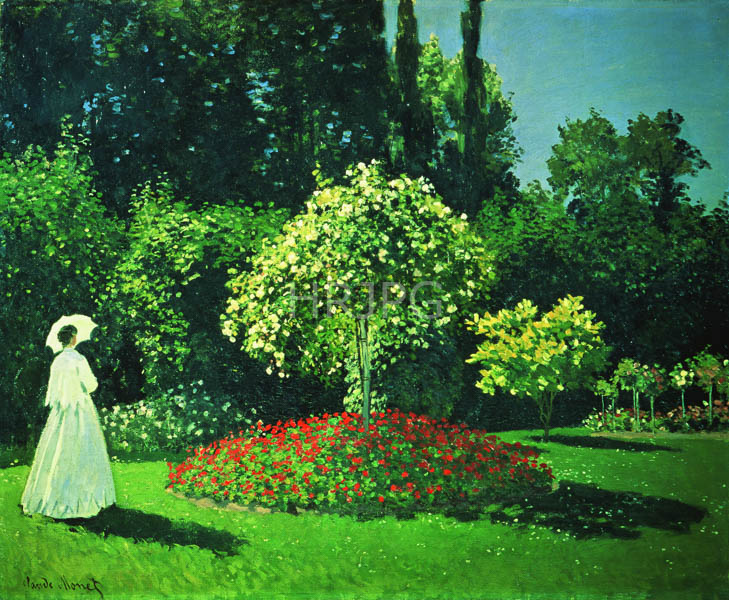
The visual center of the painting is undoubtedly the brilliant white dress worn by Jeanne-Marguerite. Monet uses this white garment as a canvas for his study of light and shadow. Rather than using simple grays or blacks to define the folds of the fabric, he introduces subtle blues and purples in the shadowed areas, reflecting the color of the sky and the surrounding greenery. This technique accurately reflects how the human eye perceives color in bright daylight. The contrast between the stark white dress and the deep, saturated greens of the garden foliage creates a powerful luminosity. The figure is positioned slightly off-center, a compositional choice that suggests a candid, photographic moment rather than a formal portrait. The way the light strikes the top of her parasol and the edges of her dress gives the scene a palpable sense of warmth and immediacy, making the viewer feel as though they are standing in the sun-drenched garden alongside her.
The background of the painting is a riot of floral colors, rendered with vigorous and confident brushstrokes that prioritize texture and light over minute botanical detail. The red and pink blossoms scattered throughout the green landscape provide rhythmic accents that lead the eye through the depth of the garden. Monet's treatment of the trees and the sky shows an early departure from the smooth, blended finishes of the Salon-approved style. Instead, he uses broken brushwork to suggest the movement of air. The towering tree on the left side of the canvas provides a vertical balance to the horizontal sprawl of the garden beds. The shadows cast across the grass are not flat or dark; they are alive with reflected color, demonstrating Monet's growing understanding that shadows are merely areas of light with different chromatic temperatures. This mastery of tonal relationships allows the painting to vibrate with energy, capturing the essence of a specific time of day.
Historically, this work marks a period of significant personal and professional struggle for Monet. Despite the radiant beauty of the scene, Monet was facing severe financial difficulties and a lack of recognition from the official Paris Salon. However, his commitment to his artistic vision remained unshaken. In this work, he successfully integrated the figure into the landscape in a way that felt natural and unforced. Unlike many of his contemporaries who treated the landscape as a mere backdrop, Monet treats the figure and the garden as a unified whole, both subject to the same laws of light. The painting anticipates his later, more radical works where the boundaries between subject and environment would blur even further. It is a work of profound observation, where the artist’s eye acts as a prism, breaking down the world into its constituent parts of light and color before reassembling them on the canvas with emotional and visual intensity. Today, housed in the Hermitage Museum, it remains a cornerstone of the 19th-century avant-garde, illustrating the dawn of a new visual language.